NDRI Workshop on Watershed Restoration and Flood Risk Reduction
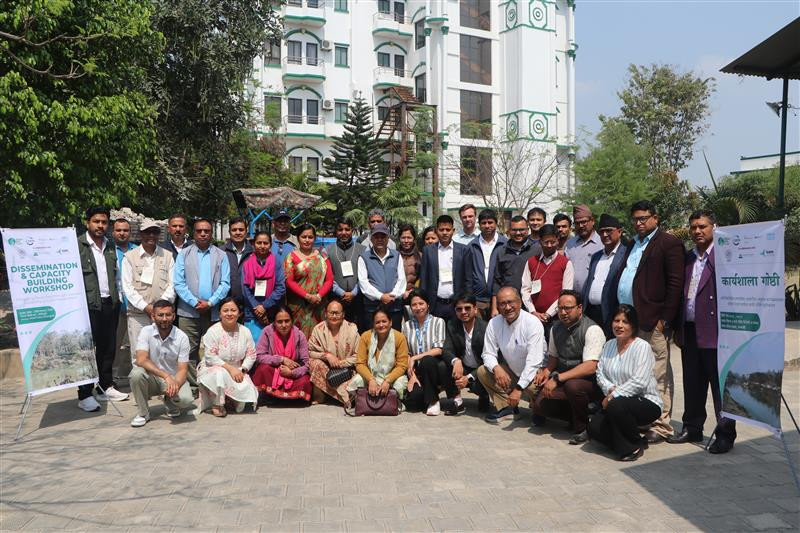
NDRI successfully organized a two-day dissemination and capacity-building workshop on
24–25 March 2026 at Hotel Rubus, Dhangadhi. The event was conducted as part of the IUCN/Global EbA Fund-supported project, “Mitigating Flood Risks through Women’s Leadership in Ecosystem-based Adaptation (EbA) Interventions.”
The workshop brought together 35 participants, including representatives from six local municipalities—Dhangadhi Sub-metropolitan City, Gauriganga Municipality, Godawari Municipality, Punarbas Municipality, Krishnapur Municipality, and Chure Rural Municipality—as well as officials from key provincial ministries such as the Ministry of Industry, Tourism, Forests and Environment (MoITFE); Ministry of Land Management, Agriculture and Cooperatives (MoLMAC); Ministry of Internal Affairs and Law; and Ministry of Physical Infrastructure Development. Representatives from local organizations, including the Nepal Red Cross Society (NRCS), also actively participated.
 The dissemination session aimed to share the key findings of the Watershed Restoration Plan (WRP), build ownership among local and provincial stakeholders, and discuss practical pathways for implementation. Complementing this, the capacity-building sessions focused on strengthening the ability of local governments, practitioners, and community representatives to understand and apply EbA measures for watershed restoration and flood risk reduction. These sessions were led by practitioners and experts who have implemented EbA initiatives across Nepal. Mr. Keshav Khanal, National Climate Adaptation and Socio-Economic Expert, presented on government initiatives on EbA in Nepal while Mr. Bikram Rana, Program Manager at Practical Action, shared the evidence from bio-dyke implementation in western Nepal. Mr. Sandesh Paneru, Economic Resilience Advisor at Mercy Corps, shared experiences from flood-responsive sugarcane farming in the far-west while Dr. Laxmi Dutt Bhatta, an NbS expert, highlighted nature-based solutions for erosion control. These sessions provided participants with practical knowledge on how EbA approaches can reduce flood and climate risks, while emphasizing gender-responsive strategies and the importance of women’s leadership in ensuring sustainable interventions.

A key highlight of the workshop was the opening remarks by the Mayor of Gauriganga Municipality, who underscored the importance of ecosystem-based approaches in addressing increasing flood risks and enhancing climate resilience. NDRI team presented the key components and findings of the WRP, followed by interactive group sessions where participants discussed implementation strategies tailored to local contexts.
The workshop concluded with a panel discussion featuring representatives from provin_1775640397.jpg) cial government, civil society, and technical experts, including Dr. Kishor Aryal (MoITFE), Ms. Jhuma Chaudhary (FECOFUN), Mr. Raj Bahadur Air (Ward representative, Dhangadhi), and Dr. Laxmi Dutt Bhatta (EbA expert and practitioner). The discussion highlighted the need for coordinated action, institutional strengthening, and continued investment in EbA to enhance resilience in the basin.
cial government, civil society, and technical experts, including Dr. Kishor Aryal (MoITFE), Ms. Jhuma Chaudhary (FECOFUN), Mr. Raj Bahadur Air (Ward representative, Dhangadhi), and Dr. Laxmi Dutt Bhatta (EbA expert and practitioner). The discussion highlighted the need for coordinated action, institutional strengthening, and continued investment in EbA to enhance resilience in the basin.
Overall, the workshop served as an important platform to bridge science, policy, and practice, fostering collaboration and strengthening momentum for the implementation of EbA-based watershed restoration in the Mohana–Khutiya basin.
