22nd NDRI Annual General Meeting
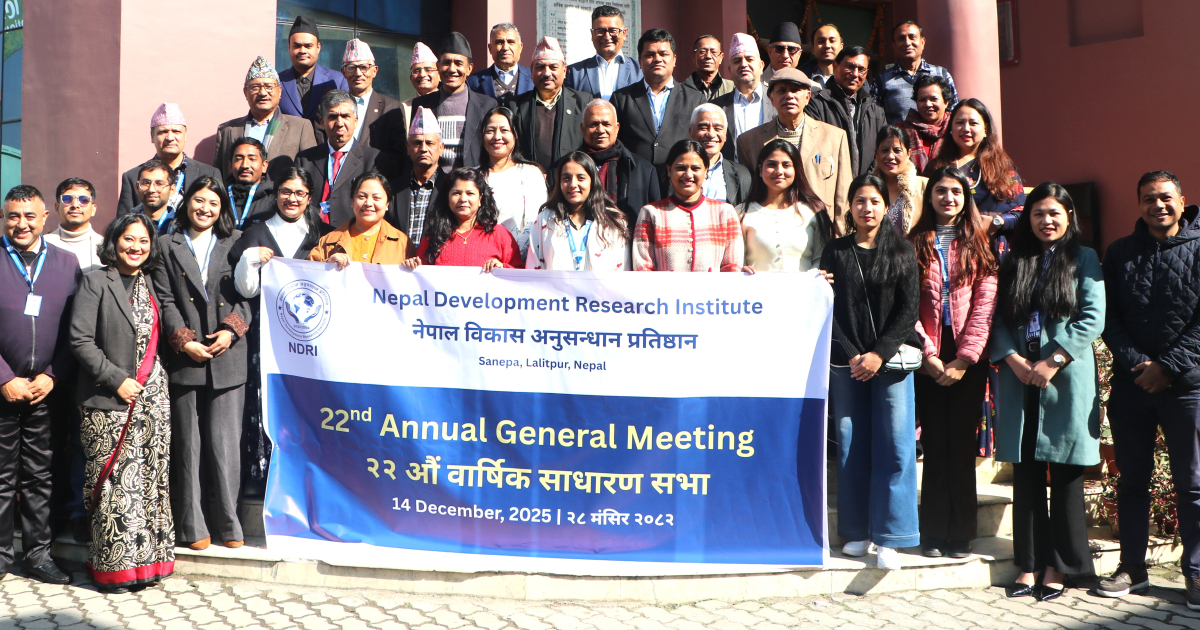
Date: 14-Dec-2025
Nepal Development Research Institute (NDRI) successfully concluded its 22nd Annual General Meeting (AGM) on the 14th of December 2025, at the National Federation of Cooperatives' Conference Hall at Pulchowk, Lalitpur. The event was held in two parts: an open session featuring distinguished guests from the government, development, and scientific communities, and a closed session where institutional decisions and leadership elections were finalized. Dr. Rudra Suwal, Sr. Research Specialist at NDRI, welcomed all the distinguished guests. NDRI's overall presentation of the fiscal year was delivered by Executive Director, Dr. Shikha Thapa Magar, who focused on what has been achieved over the year in terms of research, advocacy, and outreach. One of the major agendas of the event was the unveiling of the NDRI Annual Report 2024/25.

Er. Ganesh Shah, Former Minister of Science and Technology, was invited as a Special Guest, who commended NDRI’s longstanding contributions to national development through research and evidence-based analysis. In his remarks, he emphasized the need for a dedicated Nepal Think Tank Forum, encouraging NDRI to take the lead in creating a collaborative platform for think tanks across the country. Highlighting global energy challenges, he noted that Nepal must prioritize energy-focused research, with institutions like NDRI playing a critical role in guiding national discourse and policy planning.
Special Guest Dr. Manohara Khadka, Country Representative of International Water Management Institute (IWMI) Nepal, acknowledged the strong potential for future collaboration. She highlighted opportunities to work together on water supply and demand management, noting that such cooperation would significantly help amplify the mission and vision of both institutions. Dr. Khadka expressed appreciation for NDRI’s achievements over the years, praising the quality, consistency, and credibility of its research outputs. She stressed the importance of joint advocacy through global connectivity, reinforcing that integrated water management is a shared priority requiring collective expertise.

Similarly, Special Guest Mr. Anil Pokharel, Natural Disaster Scientist and Former CEO of National Disaster Risk Reduction And Management Authority (NDRRMA), highlighted the importance of strengthening Nepal’s disaster preparedness systems. He encouraged NDRI to advance its work on risk assessment models, expand collaboration on capacity-building initiatives, and provide broader orientation and training on such models to institutions across the country. Reflecting on past collaborations between NDRRMA and NDRI, he praised the quality of jointly produced dialogues, analyses, and reports, noting that NDRI has consistently demonstrated technical rigor and reliability.
_1766986635.JPG)
In his closing remarks, Dr. Krishna Pahari, Chair of NDRI, emphasized the institute’s commitment to cultivating an inclusive, multi-generational workforce. “NDRI includes all age groups within our professional community, enabling us to draw from diverse experiences and perspectives,” he stated. Dr. Pahari reaffirmed NDRI’s vision of becoming a leading institution that supports and strengthens evidence-based policymaking in Nepal, underscoring the organization’s dedication to impactful research and national service.
The closed session of the AGM reviewed and endorsed the annual and financial reports, discussed institutional commitments for the upcoming fiscal year, and concluded with the election of a new Executive Committee. The newly elected leadership is as follows:
- President: Dr. Jaya Kumar Gurung
- Vice President: Dr. Manjeshwori Singh
- General Secretary: Dr. Nawa Raj Khatiwada
- Treasurer: Dr. Rabita Shrestha Mulmi
- Secretary: Dr. Shankar Shrestha
- Executive Members: Dr. Divas B. Basnyat, Prof. Dr. Tara Nidhi Bhattarai

The AGM concluded with renewed commitment, strengthened partnerships, and a shared vision for advancing research-driven development, disaster resilience, and strategic policy advocacy in Nepal.